Financial Literacy
Financial Literacy Course for Kids
30 interactive lessons on saving, budgeting, banking, and digital money — Class 3 to 12
- Grades
- Class 3–12
- Duration
- 31 live sessions
- Projects
- 12 modules
- Rating
- 4.8 (128+)

30 Lessons
- Saving, budgeting & smart spending choices
- Banks, UPI, QR codes & digital payment safety
- Mock shopping, budgeting games & money quizzes
- 31 live sessions of project-based classes
What Financial Literacy covers
GeekashramJr's Financial Literacy course delivers 30 interactive live lessons across 12 modules for Class 3–12: money basics, needs vs wants, saving, budgeting, banking, digital payments (UPI/QR), earning, smart spending, investing awareness, financial safety, giving back, and a final assessment with certificate. Students complete budgeting games, mock shopping activities, and savings challenges with age-appropriate mentor guidance.
By the end, your child will have
- Created a personal budget and savings plan with short- and long-term goals
- Demonstrated safe UPI/digital payment habits and scam-awareness checklist
- Passed the final financial literacy assessment and earned a completion certificate
- Interactive live lessons
- 31Interactive live lessons
- Practical money modules
- 12Practical money modules
- Digital payment & scam awareness
- SafeDigital payment & scam awareness
- Completion certificate
- CertCompletion certificate
This course is for your child if they are…
A Young Saver
Wants to understand pocket money, piggy banks, and saving goals.
A Smart Spender
Needs help telling needs from wants and comparing prices wisely.
A Digital Learner
Curious about UPI, online payments, and staying safe from scams.
A Future Planner
Ready to learn budgeting, banking basics, and responsible money habits.
Financial Literacy syllabus at a glance
Typical full-course pace: 31 live sessions. Modules run in order, and mentors adjust depth to the student.
| # | Module | Duration | Topics covered | Projects |
|---|---|---|---|---|
| 1 | Introduction to Money | 2–3 lessons | History of money; Coins, notes, and digital money; How money is used in everyday life | Mentor-guided practice builds |
| 2 | Needs vs Wants | 2–3 lessons | Difference between needs and wants; Making smart spending choices; Prioritising what matters most | Mentor-guided practice builds |
| 3 | Saving Money | 2–3 lessons | Why saving matters; Piggy bank and saving jars; Setting short- and long-term saving goals | Mentor-guided practice builds |
| 4 | Budgeting | 2–3 lessons | Simple personal budget; Family budget basics; Planning income and expenses | Budget planning activity |
| 5 | Banks & Banking | 2–3 lessons | What banks do; Bank accounts, ATM, and passbook; Cheque and debit card basics | Mentor-guided practice builds |
| 6 | Digital Payments | 2–3 lessons | UPI and QR code payments; Online payment basics; Digital safety and responsible use | Mentor-guided practice builds |
| 7 | Earning Money | 2–3 lessons | Jobs and businesses; Introduction to entrepreneurship; The value of work and effort | Mentor-guided practice builds |
| 8 | Spending Wisely | 2–3 lessons | Compare prices before buying; Avoid impulse buying; Smart shopping habits | Mock shopping activity |
| 9 | Investing Basics | 2–3 lessons | Difference between saving and investing; Awareness of FD, RD, mutual funds, and stocks; Long-term money growth concepts (age-appropriate) | Mentor-guided practice builds |
| 10 | Financial Safety | 2–3 lessons | Common scams and fraud awareness; OTP safety and strong passwords; Cyber fraud and how to stay protected | Mentor-guided practice builds |
| 11 | Giving Back | 2 lessons | Donations and charity; Responsible use of money; Sharing and community support | Mentor-guided practice builds |
| 12 | Activities & Assessment | 2–3 lessons | Budgeting games and savings challenges; Financial quizzes and group discussions; Final financial literacy assessment | Budget planning activity; Mock shopping activity; Savings challenge; Certificate of completion |
Projects students actually build
A sample of the work that comes out of Financial Literacy — every one built live with a mentor, not followed along from a video.
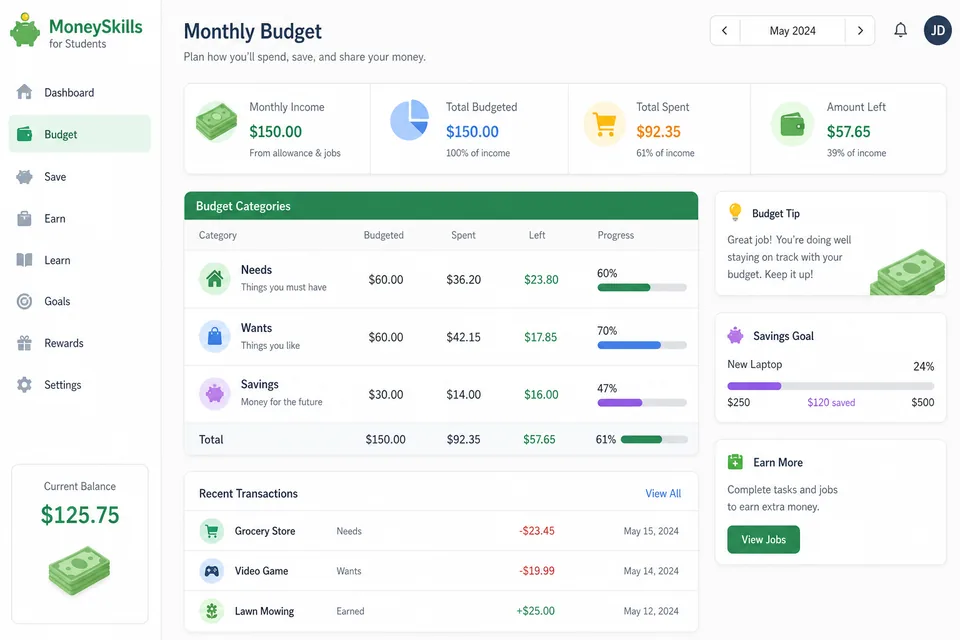
Personal budget workbook
Students build a simple monthly budget separating needs, wants, and savings — applied to pocket money or allowance scenarios.
- Budgeting
- Needs vs wants
- Goals
Mock shopping challenge
A live classroom activity comparing prices, avoiding impulse buys, and choosing the best value — smart spending in practice.
- Smart spending
- Comparison
- Decision making

Savings challenge & certificate
A multi-week savings tracker plus final quiz covering banking, digital safety, and responsible money habits.
- Saving
- Safety
- Assessment
Skills covered
- Saving & budgeting
- Needs vs wants
- Banking basics
- UPI & digital payments
- Scam awareness
- Investing awareness
Prerequisites & who can join
No prior knowledge needed. Designed for Class 3–12 with age-appropriate examples, worksheets, and live mentor guidance. A laptop or tablet with stable internet is enough to start.
- Grade range
- Class 3–12
- Estimated duration
- 31 live sessions
- Class format
- Live online with GeekashramJr mentors
Financial Literacy — questions parents ask
Straight answers on syllabus depth, projects, pace and pricing for live Financial Literacy classes.
GeekashramJr's Financial Literacy course delivers 30 interactive live lessons across 12 modules for Class 3–12: money basics, needs vs wants, saving, budgeting, banking, digital payments (UPI/QR), earning, smart spending, investing awareness, financial safety, giving back, and a final assessment with certificate. Students complete budgeting games, mock shopping activities, and savings challenges with age-appropriate mentor guidance.
Financial Literacy is taught live module by module (31 live sessions). Parents can review the full syllabus table on this page — topics, projects, and typical session time per module — plus download the curriculum brochure.
Students complete mentor-guided projects throughout the course. By the end they typically have: Created a personal budget and savings plan with short- and long-term goals; Demonstrated safe UPI/digital payment habits and scam-awareness checklist; Passed the final financial literacy assessment and earned a completion certificate. Sample project screenshots and walkthroughs are shown above.
Financial Literacy is for students in Class 3–12 (Class 3 to 12 at GeekashramJr). No prior knowledge needed. Designed for Class 3–12 with age-appropriate examples, worksheets, and live mentor guidance. A laptop or tablet with stable internet is enough to start.
GeekashramJr Explorers starts at ₹499 per session (5 students), Champions is ₹799 per session (3 students), and Super Mentors 1:1 is ₹999 per session. Try a session to see the teaching style before choosing a plan. The trial fee is adjusted on enrolment.
Classes are live online with GeekashramJr mentors — not passive video courses. Students get real-time feedback, debugging help, and project reviews in every session.
Students learn saving, budgeting, banking, UPI and digital payments, smart spending, investing awareness, financial safety, and responsible money habits through 30 interactive live lessons.
Yes. The course is designed for Class 3–12 with age-appropriate examples, worksheets, games, and live mentor guidance — no prior finance knowledge needed.
Yes. Modules cover UPI/QR basics, OTP safety, scam awareness, and responsible digital money habits suitable for school students.
Yes. Students complete a final assessment covering key money skills and earn a completion certificate after the savings challenge and review activities.
Related reading
Parent guides and STEM articles that pair well with Financial Literacy.
Not sure which track fits your child?
Book a 45-minute trial session. A mentor works with your child, sees how they think, and recommends the track. The trial fee is adjusted if you continue.