Entrepreneurship
Startup & Entrepreneurship Course for Kids
30-hour Startup & Entrepreneurship Program — from idea to market for Class 6–12
- Grades
- Class 6–12
- Duration
- 31 live sessions
- Projects
- 11 modules
- Rating
- 4.9 (96+)
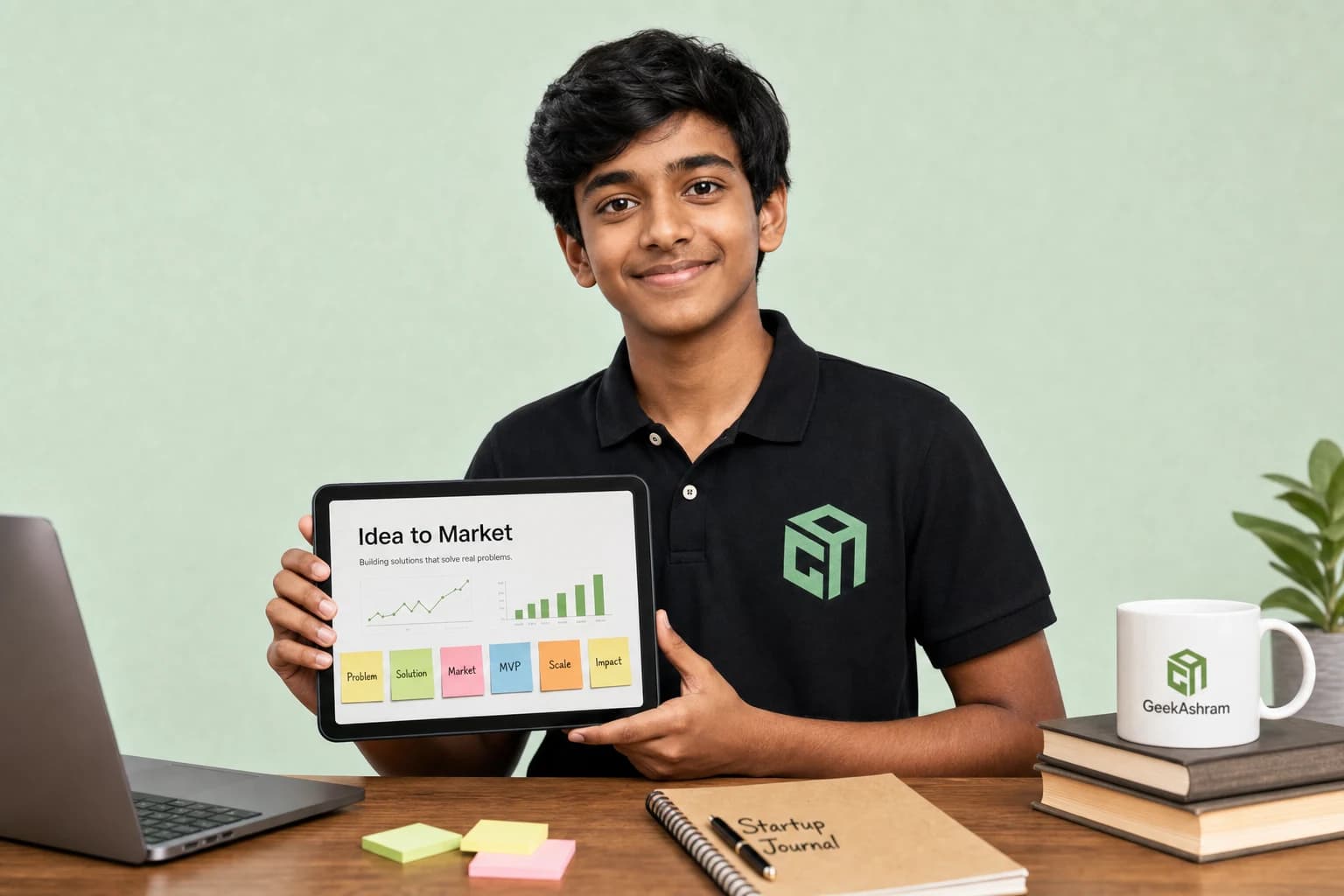
30 Classes
- Spot problems & generate innovative startup ideas
- Talk to customers, validate ideas & build a simple MVP
- Business model, costing, branding, funding & pitch deck
- 31 live sessions of project-based classes
What Entrepreneurship covers
GeekashramJr's Startup & Entrepreneurship course is a 30-hour live program for Class 6–12 students covering 11 modules: entrepreneur mindset, idea generation, customer discovery, MVP design, business model & costing, branding, legal basics, funding awareness, pitch deck creation, and a virtual Demo Day. Students keep a Startup Journal and leave with a validated idea, simple prototype, and pitch presentation.
By the end, your child will have
- Validated a startup idea with customer interviews and a completed Startup Journal
- Built a no-cost MVP prototype and a business model canvas with pricing logic
- Delivered a Demo Day pitch with slide deck and mentor feedback
- Live entrepreneurship classes
- 31Live entrepreneurship classes
- Modules from idea to Demo Day
- 11Modules from idea to Demo Day
- Prototype & pitch deck built
- MVPPrototype & pitch deck built
- Virtual Demo Day showcase
- DemoVirtual Demo Day showcase
This course is for your child if they are…
A Problem Spotter
Notices everyday frictions at home, school, or in the community and wants to fix them.
A Young Founder
Dreams of building something of their own — Borders, services, or digital products.
A Confident Communicator
Wants to pitch ideas clearly, talk to customers, and present on stage or online.
A Future Leader
Ready for design thinking, business basics, and India's startup ecosystem.
Entrepreneurship syllabus at a glance
Typical full-course pace: 31 live sessions. Modules run in order, and mentors adjust depth to the student.
| # | Module | Duration | Topics covered | Projects |
|---|---|---|---|---|
| 1 | Becoming an Entrepreneur | 2–3 hours | Job vs business vs startup vs innovation; Growth mindset and learning through iteration; Problems as opportunities: needs, wants, and luxuries | Note 20 problems from home/school; Interview family about daily bottlenecks |
| 2 | Finding Ideas | 2–3 hours | Methods of finding ideas from experience and tech shifts; Brainwriting, Crazy 8, and mind-mapping; Filter matrix: passion, skills, market size, and impact | Generate 50 startup concepts; Filter down to Top 3 ideas |
| 3 | Customer Discovery | 2–3 hours | User vs customer vs decision maker; Neutral interview questions and unbiased feedback; Problem validation with simple surveys | Customer persona sheet; Interview 10 potential customers; Collect 15 survey responses |
| 4 | Design Thinking | 2–3 hours | Empathize, Define, Ideate, Prototype, Test; SCAMPER and the 5 Whys; Paper MVPs, Canva, and Figma mockups | Build a no-cost visual prototype / MVP |
| 5 | Business Fundamentals | 2–3 hours | Value proposition canvas; Business Model Canvas (9 sectors, youth-friendly); Fixed vs variable costs, pricing, and margins | 1-page business model; Expense list for 10 units |
| 6 | Branding & Marketing | 2–3 hours | Brand name, logo, and tagline; Word-of-mouth vs Instagram and WhatsApp Business; Sales skills: utility over specs | Canva logo & catchphrase; Product launch poster; Sell Me This Pen exercise |
| 7 | Technology & AI | 2 hours | APIs, maps, AI helpers, and automation in startups; Canva, Google Forms, Sheets, and LLM prompts | Outline one automation layer; Finalize digital pitch poster |
| 8 | Legal Basics | 2 hours | Sole Proprietorship, LLP, Pvt Ltd; PAN, GST, Udyam; Startup India, trademarks, copyrights, and patents; Ethics: privacy, governance, and social impact | Trademark name search; List 3 core company values |
| 9 | Funding & Ecosystem | 2–3 hours | Bootstrapping, crowdfunding, angels, VC, and grants; Atal Innovation Mission, incubators, and state cells; Student innovation challenges and Inspiration Awards | Phase 1 startup budget; Identify one challenge to enter |
| 10 | Pitch Masterpiece | 2–3 hours | Project report: summary, market size, costs, growth; 8–12 slide pitch deck in Canva; Pitching skills, webcam presence, and break-even basics | Draft report; Pitch deck; Financial estimation sheet |
| 11 | Demo Day | 3 hours · Demo Day | Mock presentation and peer review; Grand virtual Demo Day with mentors and incubators; Awards and completion credentials | Demo Day pitch & prototype showcase |
Projects students actually build
A sample of the work that comes out of Entrepreneurship — every one built live with a mentor, not followed along from a video.
Customer discovery & MVP
Students interview real users, document pain points, and build a paper or digital MVP to test their solution hypothesis.
- Interviews
- MVP
- Validation
Business model & brand kit
A one-page business model, simple brand name/logo direction, and cost sheet — teaching pricing and positioning.
- Business model
- Branding
- Costing
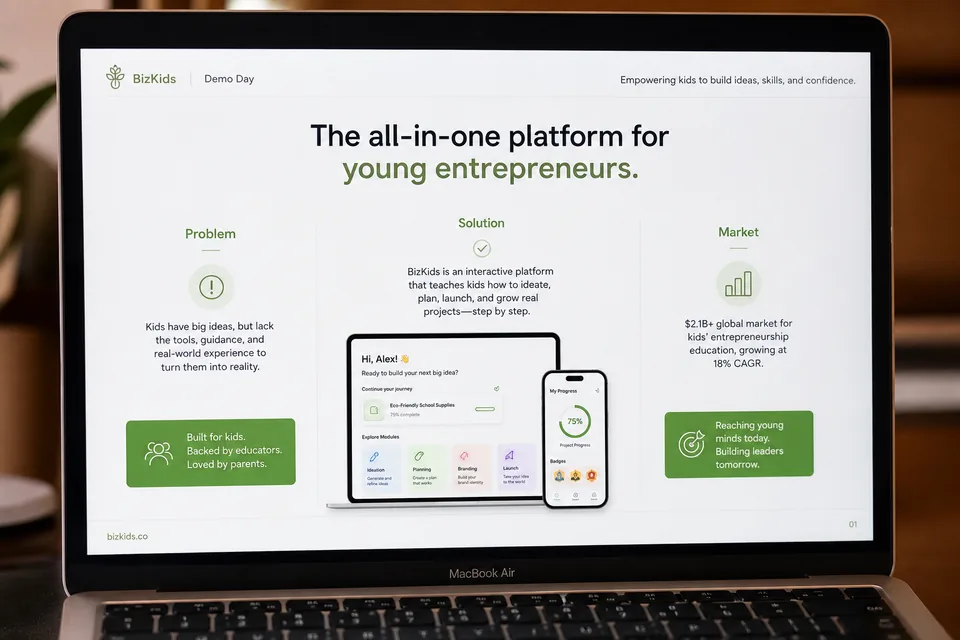
Demo Day pitch deck
A 5–8 slide pitch covering problem, solution, market, and ask — presented live to mentors on Demo Day.
- Pitching
- Slides
- Presentation
Skills covered
- Idea generation
- Customer discovery
- MVP prototyping
- Business model canvas
- Branding & pricing
- Pitch decks
Prerequisites & who can join
Designed for Class 6–12. No prior business experience needed — a laptop or tablet, stable internet, and curiosity about problems around them is enough to start. Students keep a Startup Journal throughout the course.
- Grade range
- Class 6–12
- Estimated duration
- 31 live sessions
- Class format
- Live online with GeekashramJr mentors
Entrepreneurship — questions parents ask
Straight answers on syllabus depth, projects, pace and pricing for live Entrepreneurship classes.
GeekashramJr's Startup & Entrepreneurship course is a 30-hour live program for Class 6–12 students covering 11 modules: entrepreneur mindset, idea generation, customer discovery, MVP design, business model & costing, branding, legal basics, funding awareness, pitch deck creation, and a virtual Demo Day. Students keep a Startup Journal and leave with a validated idea, simple prototype, and pitch presentation.
Entrepreneurship is taught live module by module (31 live sessions). Parents can review the full syllabus table on this page — topics, projects, and typical session time per module — plus download the curriculum brochure.
Students complete mentor-guided projects throughout the course. By the end they typically have: Validated a startup idea with customer interviews and a completed Startup Journal; Built a no-cost MVP prototype and a business model canvas with pricing logic; Delivered a Demo Day pitch with slide deck and mentor feedback. Sample project screenshots and walkthroughs are shown above.
Entrepreneurship is for students in Class 6–12 (Class 3 to 12 at GeekashramJr). Designed for Class 6–12. No prior business experience needed — a laptop or tablet, stable internet, and curiosity about problems around them is enough to start. Students keep a Startup Journal throughout the course.
GeekashramJr Explorers starts at ₹499 per session (5 students), Champions is ₹799 per session (3 students), and Super Mentors 1:1 is ₹999 per session. Try a session to see the teaching style before choosing a plan. The trial fee is adjusted on enrolment.
Classes are live online with GeekashramJr mentors — not passive video courses. Students get real-time feedback, debugging help, and project reviews in every session.
A 30-hour program where students spot problems, generate startup ideas, talk to customers, build an MVP, create a business model and pitch deck, and present on Demo Day.
The program is designed for Class 6–12 students who want to learn entrepreneur mindset, customer discovery, and pitching — with a Startup Journal built throughout the course.
Demo Day is the final showcase where students present a short pitch deck covering problem, solution, market, and ask — with live mentor feedback.
Students leave with a validated idea, simple MVP prototype, business model basics, and pitch practice. The goal is founder skills and confidence — not pressure to launch a company overnight.
Related reading
Parent guides and STEM articles that pair well with Entrepreneurship.
- Coding for Kids7 Minutes
Best Coding Language for Kids in 2026: Scratch vs Python vs JavaScript
The best coding language for kids in 2026 depends on age: Scratch for ages 7–10, Python for Class 6+ and teens, JavaScript for websites, and robotics for hands-on builders. Compare options and pick the right first path.
Read - Coding for Kids7 Minutes
What Age Should Kids Start Learning to Code? Parent Guide | 2026
Most kids can start coding around ages 7–8 with visual tools; typed languages like Python usually fit better from Class 5–6. Here is a clear age-by-age parent guide for when to start coding in 2026.
Read
Not sure which track fits your child?
Book a 45-minute trial session. A mentor works with your child, sees how they think, and recommends the track. The trial fee is adjusted if you continue.